
Raman Microscopes
Explore Brukers range of Raman microscopes tailored to your analysis needs. You can choose from three distinct options:
- SENTERRA II: A dispersive Raman microscope featuring classical NIR/VIS excitation lasers.
- RAMANtouch: Our latest addition, an advanced confocal Raman microscope offering the world's fastest high-quality Raman imaging through patented laser scanning technology.
- RamanScope III: An FT-Raman microscope equipped with an NIR laser for precise analysis.
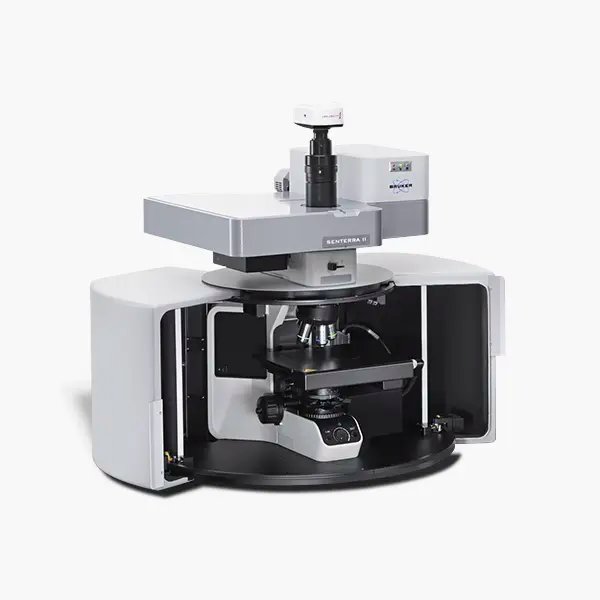

Bruker provides the most comprehensive product portfolio in Raman microscopy, from advanced confocal 3D Raman systems to ultrafast galvano scanner-based imaging and specialized solutions for a wide range of applications. Its confocal Raman microscopes deliver high-definition chemical mapping and hyperspectral 3D imaging with sub-micron spatial resolution, making them ideal for materials science, life science and geology, with advanced confocal optics, sharp spectral clarity and user-friendly automation for fast, reliable, data-rich scans. The Nanophoton series is built on fast, precise galvano scanning technology, enabling innovative Raman imaging modes using a laser line or AreaFlash, while the SENTERRA II is the µ-Raman benchmark for user convenience, safety and precision, delivering 100% reliable Raman micro-chemical analysis. Raman microscopy analyzes 2D and 3D structures chemically, allows depth profiling and can even analyze objects behind transparent materials.
Key features:
• Confocal 3D Raman imaging with sub-micron spatial resolution
• Nanophoton series — fast galvano scanning with laser-line or AreaFlash imaging
• SENTERRA II — µ-Raman benchmark for convenience, safety and precision
• Hyperspectral 3D chemical mapping combining spatial and spectral data
• Depth profiling, including through transparent materials
Typical applications:
• Materials science and geology characterization
• Life science research requiring chemical mapping
• Micro-chemical analysis and component-distribution studies
Get in touch

Premium quality laboratory equipment and services.
© 2026 All rights reserved.